.svg)

Right Things

A ten-minute check for any leader whose team is busy, working hard, and not moving the thing that matters.
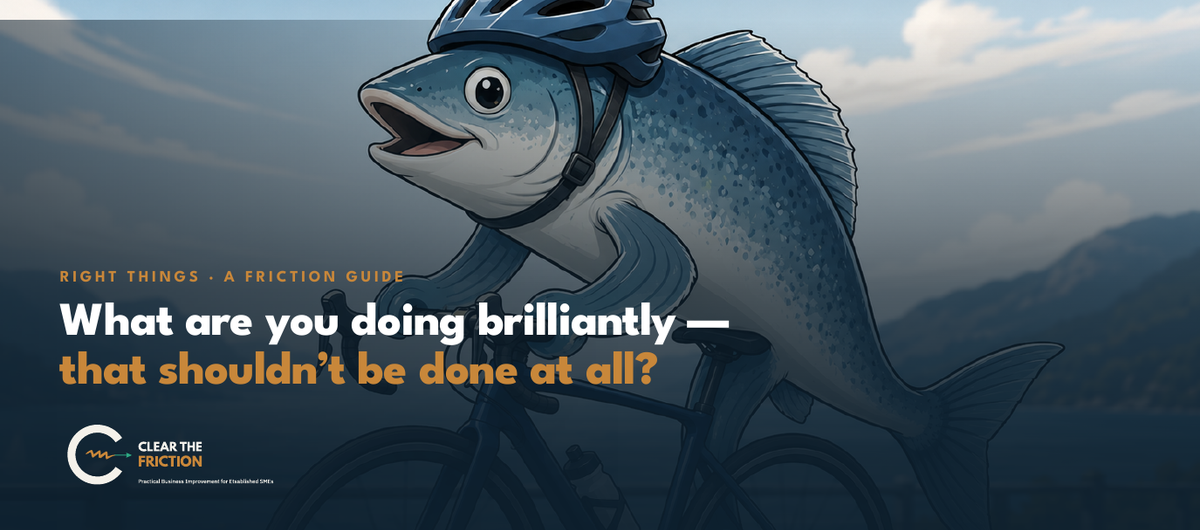
Years ago, our Marketing Director sat in a meeting, listened to an update on a project we were pouring money into and described it as a bicycle for fish.
A beautifully designed bicycle.
Well engineered.
Carefully built.
And completely useless, because fish do not ride bicycles.
She was right.
Everyone in the room knew she was right. You could feel the truth of it land.
Then the meeting moved on.
And we carried on building the bike.
That experience taught me an important distinction:
Doing something well is not the same as doing something worthwhile.
Most business-improvement effort begins with questions such as:
Those are sensible questions.
But they assume the work deserves to exist.
Sometimes the better question is:
Why are we doing this at all?
Most businesses contain work that no longer deserves to exist.
The report was requested years ago by someone who has since left.
The meeting was introduced after a problem that no longer occurs.
The approval stage was added following one mistake and has never been challenged.
The spreadsheet duplicates information already held elsewhere.
The project continues because stopping it would mean admitting that the time already spent will not come back.
None of this work necessarily looks badly managed.
It may be:
That is what makes it dangerous.
You are not always wasting time because people are doing poor work.
You may be wasting time because they are doing unnecessary work extremely well.
From inside an organisation, busyness and business can feel almost identical.
Both involve:
But only one produces the result the business needs.
Busyness is motion.
Business is progress.
The wrong work survives because everyone involved is genuinely busy. There is no obvious laziness to attack. Nobody looks idle. People may even be proud of what they produce.
Yet customers, margin, delivery or growth do not improve.
The activity continues because it is familiar, visible and safe.
Stopping it would require somebody to challenge why it exists.
Take any recurring task, report, meeting, process or project and ask:
Can we draw a clear line between this work and a result the business currently needs?
The result might be:
Be strict.
If the explanation requires several rounds of:
Well, indirectly…
then the work deserves challenge.
Indirect value can be real. Not every valuable activity produces immediate revenue. Planning, quality assurance, training and maintenance all matter.
But the connection should still be explainable.
When nobody can clearly describe what the work contributes, history and habit have probably replaced purpose.
In the bicycle-for-fish meeting, the problem was not insight.
The Marketing Director saw the issue clearly and named it perfectly.
Others in the room knew she was right.
What was missing was the courage to act.
Stopping work is uncomfortable.
It can mean:
Busyness is safer.
Nobody is usually criticised for appearing busy.
The person who challenges the work may be accused of being negative, difficult or resistant.
So the work survives.
Not because nobody can see the waste.
Because stopping it carries a social and political cost.
When unnecessary work continues, the loss is not only the time and money spent on it.
The greater loss is what that resource could have been doing instead.
Every hour spent producing a report nobody uses is an hour not spent solving a customer problem.
Every meeting that adds little value delays another conversation that matters.
Every approval stage consumes management attention.
Every unnecessary project occupies people who could be improving delivery, winning customers or reducing risk.
The cost is not only the bicycle.
It is the useful work that never happened because everyone was building it.

Ask your leadership team to identify one example in each category.
Who uses it?
What decision does it improve?
What would happen if it stopped for a month?
What decision, coordination or problem-solving purpose does it serve?
Does that purpose still exist?
Could it be handled faster or by fewer people?
What risk is the approval controlling?
Is the level of control proportionate?
Could clear decision boundaries replace repeated sign-off?
Why does it exist?
Is the same information already created elsewhere?
Could the need itself be removed before automating it?
Should it:
Do not allow “carry on for now” to become the default because the decision feels awkward.
Businesses often respond to overload by trying to make everything more efficient.
They introduce:
Those may help.
But improving the efficiency of unnecessary work only makes you better at wasting time.
Before asking how to optimise it, ask whether it should survive.
A faster bicycle is still no use to a fish.
That explains how the work started.
It does not prove it still matters.
Businesses change.
Customers change.
Systems change.
Risks change.
People change.
Work that was once necessary may no longer be useful. A good decision made five years ago can become poor practice today if nobody revisits it.
History deserves respect.
It does not deserve automatic obedience.
Pick one thing your team spends meaningful effort on.
Draw the line between the activity and the result.
Ask the people closest to it:
Then make one decision.
Stop it.
Simplify it.
Redesign it.
Or defend it with a clear reason.
The goal is not to create a culture where everything is constantly questioned, and nothing settles.
The goal is to make sure work survives because it matters, not simply because it exists.
Low-value work is rarely an isolated problem.
It is often connected to unclear priorities, weak decision-making, outdated processes, overloaded managers and a culture where stopping work feels harder than starting it.
The Friction Diagnostic will help you step back and consider where friction may be affecting your people, processes and commercial performance.
You will receive a structured view of the areas that may warrant closer attention, along with a clearer starting point for deciding what to investigate first.

Progress, not perfection. You won't audit everything this week. Find the one bicycle for fish — and be brave enough to name it out loud.
Find the friction. Focus the team. Fix what matters.